
Tile Hole Master
PineappleGameArcade
3.953.00 Reviews
- Version
- 1.3.1
- Installs
- 100.00K
- Age Rating
- Mature 17+
Screenshots

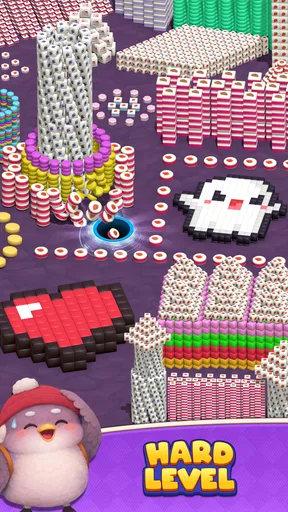
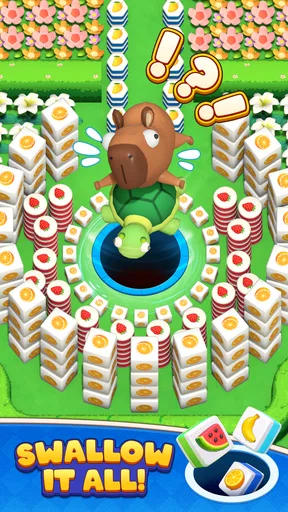

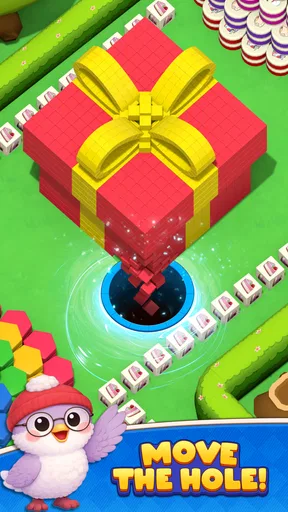


Our Review of Tile Hole Master
 Analysis by Appyee
I went into Tile Hole Master expecting a quick arcade distraction, and that is exactly where it makes the most sense. The idea is easy to understand: guide a moving hole across a three-dimensional board, absorb matching tiles, and clear the layout before a mistake ruins the run. It is simple enough to pick up without instructions, but the changing board shapes make each attempt more active than a basic tap-to-score game.
What makes the game worth considering is its middle ground between an arcade title and a light puzzle game. You are not only reacting quickly; you are also deciding which tiles to take first, how to position the hole, and when a shortcut is safer than a direct route. I found that combination more interesting than the store summary initially suggests. At the same time, it is not a deep strategy game, and players looking for long-term complexity may eventually want something richer.
How I judged the game before recommending it
My first decision point was the control scheme. A casual arcade game needs movement that feels immediate, because even a small delay can make a simple challenge frustrating. Here, the central action is clear from the opening moments: move the hole around the board and let it swallow tiles. That direct interaction lowers the learning curve and makes the game suitable for short sessions, especially when I only have a few minutes to spare.
The second criterion was whether the puzzle layer adds meaningful choices. If every board can be solved by sweeping randomly, the novelty fades quickly. I paid attention to the order in which I approached groups of tiles. A useful habit is to scan the whole board before moving, identify the most isolated pieces, and then plan a route that avoids wasting movement around empty spaces. This small pause turns the game from pure reflex play into a more deliberate arcade puzzle.
The visual presentation also matters because the boards use a three-dimensional style. Depth can make a layout more appealing, but it can also make distances and tile positions harder to read. I found that I played more accurately when I treated the board as a route-planning problem rather than relying on quick swipes. If you prefer flat, instantly readable puzzle grids, the 3D perspective may take a little adjustment.
Another practical question is session length. This is best approached as a pick-up-and-play game, not as a replacement for a full-length puzzle campaign. It fits a commute, a waiting room, or a short break particularly well. The basic loop is understandable without a long tutorial, so I could start playing immediately instead of spending the first session learning menus and systems.
Tile Hole Master is free to download, which makes trying it straightforward. It includes optional in-app purchases ranging from ninety-nine cents to thirty-eight dollars and ninety-nine cents per item. That price range is worth keeping in mind before committing to extended play. I would begin with the free experience and decide later whether the extra spending feels justified, rather than treating the purchase options as part of the reason to install it.
The core loop is clearer than it first appears
The most satisfying part of a board is not simply watching tiles disappear. It is finding a clean sequence. I often began by moving toward a nearby cluster, then used the newly opened space to reach pieces that looked awkward from the starting position. This creates a pleasant rhythm: observe, move, swallow, reassess. The board changes as tiles vanish, so a route that looked inefficient at the beginning can become the best option a few seconds later.
A useful tip is to avoid rushing toward the largest visible group. Large clusters are tempting because they seem to offer fast progress, but they can also pull the hole away from smaller pieces that are harder to reach later. I had better results when I cleared inconvenient edges first and left a central group for the final movement. That approach is not a universal solution, but it reduces the chance of ending with a single troublesome tile stranded behind the route I already used.
The 3D layout also rewards checking the board from more than one angle before committing. When several tiles appear close together, the perspective can make their actual path less obvious. I found it helpful to make short movements rather than one long sweep whenever the hole was near a corner or narrow section. Short corrections feel slower, but they prevent the kind of accidental detour that can turn a simple board into a messy one.
That is one of the game’s less obvious strengths: it gives careful players something to do without covering the screen in complicated controls. The challenge comes from interpreting space and timing movement, not from memorizing a large rulebook. For younger players, that can make the game approachable, although the listed content rating is Mature 17+, so families should check the platform information and decide whether it is appropriate for their household.
Where it wins against familiar arcade choices
Compared with an endless runner, this game gives me more control over the outcome. Endless runners are excellent when I want constant motion and quick reactions, but they often depend on repeating patterns of dodging and collecting. Here, the board stays in front of me and the main challenge is deciding how to clear it. That makes the experience calmer and more thoughtful, even though it still belongs to the arcade category.
It also feels more active than a traditional match-style puzzle when I want movement to matter. Match games usually focus on selecting combinations and watching the board resolve them. Tile Hole Master puts my position at the center of the action. I am responsible for steering toward the pieces, so the satisfaction comes from executing a route as well as recognizing a solution.
Against minimalist hole-collection games, its themed 3D boards provide more visual variety than a single repeated arena would. The themes help the basic mechanic feel less like a demonstration and more like a sequence of small challenges. I would not call the presentation elaborate, but it gives the simple act of swallowing tiles enough context to stay pleasant during short sessions.
The developer, PineappleGame, has chosen a mechanic that communicates quickly. I did not need to study a complex control layout or understand a large progression system before the first useful decision. That is a real advantage for players who dislike games that bury the main attraction beneath menus, currencies, or lengthy explanations.
Small tactics that make difficult boards easier
My most reliable tactic was to divide each board into zones. I mentally marked the nearest area, the far edge, and any narrow passage between them. Clearing one zone at a time kept the hole from zigzagging unnecessarily. It also made failures easier to understand: if I became stuck, I could usually see that I had left an isolated tile in the wrong zone rather than blaming the controls.
I also learned to use empty space as a resource. Once tiles disappear, the hole can move through areas that were previously blocked or visually crowded. Instead of immediately heading for the next obvious piece, I sometimes moved into the newly opened area first. That gave me a better angle for the next group and reduced the number of sharp turns needed afterward.
A third tip is to treat the final few tiles differently from the opening. Early in a board, exploration is relatively safe because there are many possible routes. Near the end, every remaining piece matters, and a careless sweep can send the hole away from the target. I slowed down for the last section and used smaller directional changes. This is where the arcade pressure becomes most noticeable, because the board looks almost complete while still demanding attention.
These tactics are useful because they do not depend on an invented power-up system or a complicated build. They come directly from the relationship between the hole, the tile arrangement, and the available space. Players who enjoy discovering efficient routes will probably get more from the game than players who only want to move continuously.
What may limit the appeal
The same simplicity that makes the game accessible can limit its staying power. The central action remains consistent: move, swallow, and clear. If you need a strong story, character development, competitive rankings, or a large collection of distinct mechanics, this will feel narrow. I enjoyed the clarity, but I could also see myself switching to another puzzle game after a session if I wanted a deeper sense of progression.
The 3D presentation is attractive, but it is not automatically easier to read. On a smaller phone screen, a crowded board may require more careful movement than a flat grid. Players with limited patience for correcting a route may find that friction more noticeable than the puzzle itself. I would recommend trying a few boards before deciding whether the perspective feels comfortable.
The free entry point is helpful, but the available purchase range changes how I evaluate long-term play. A free game with optional spending can be perfectly reasonable when the base loop is satisfying, yet I would still avoid buying anything during the first session. Play long enough to learn whether the board-clearing mechanic remains enjoyable for you; the novelty of swallowing tiles can be strong at first and less compelling later.
The Mature 17+ rating is another reason not to assume this is a universal family game simply because the controls are easy. Ease of play and age suitability are different questions. I would check the rating before handing it to a younger player, especially if the device is shared among family members.
Who should choose it, and who should look elsewhere
I would recommend it to someone who likes compact puzzle challenges with an arcade feel. It is especially suitable for players who enjoy planning a route, correcting mistakes quickly, and seeing a board become empty through their own movement. It also works well for a person who wants something more interactive than a passive time-filler but less demanding than a large strategy title.
A realistic use case is a short break between tasks. I could open the game while waiting for a meeting or during a brief pause, play a few boards, and close it without needing to remember a complicated story or manage a long quest. The clear objective makes it easy to return after a day away. That convenience is one of its strongest practical qualities.
I would steer competitive players toward a different kind of arcade game if their priority is head-to-head action or a visible global ranking. I would also suggest a more traditional logic puzzle for anyone who wants layered deduction, written clues, or solutions that can be studied for a long time. Tile Hole Master is about spatial movement and quick board decisions, not about building an intricate theory of a puzzle.
Players who dislike optional purchases should approach it with a firm personal rule: enjoy the free portion first and do not spend simply because a board becomes challenging. The game can be evaluated without immediately paying, and that makes the decision easier. If the basic loop does not hold your attention, additional spending will not fix the underlying mismatch.
Switching from another arcade game
The cost of switching is low if you are coming from a simple casual title. The controls and objective can be understood quickly, and there is no need to learn a large cast of characters or a complicated set of abilities. Your main adjustment is mental: instead of reacting to objects arriving at you, you are actively steering through a board and choosing the order in which the pieces disappear.
Switching is less attractive if your current favorite already offers endless variety, precise competitive play, or a strong long-term progression system. In that situation, this game may feel like a pleasant side option rather than a full replacement. I would keep it as a compact alternative for slower moments, not uninstall a deeper favorite solely because this mechanic is immediately accessible.
Device compatibility is reasonably broad for a modern casual game. It runs on Android versions from 8.0 onward, so many older supported phones can try it without requiring a recent operating system. The current release is version 1.3.1, which is useful to know when checking whether your installation matches the version discussed here.
Its reach is already significant, with over one hundred thousand installs and an average rating of three point nine from around two thousand four hundred ratings. Those figures suggest a game that has attracted a real audience while still producing mixed reactions. I read that as a reason to try it personally rather than assuming it will suit everyone. The title also has fifty-three written reviews, so the numerical rating is more useful as a broad signal than as a complete description of every player’s experience.
My recommendation after playing
Tile Hole Master is a good choice when you want a free arcade puzzle built around movement, spatial awareness, and quick board clearing. PineappleGame keeps the central idea understandable, while the themed 3D layouts give the mechanic enough variation to support short repeat sessions. I especially liked the moments when a careful route turned a crowded board into a clean finish.
My recommendation is conditional rather than automatic. Install it if you enjoy steering-based puzzles and prefer short, self-contained challenges. Start without spending, test how comfortable the 3D boards feel on your phone, and pay attention to whether planning routes remains fun after the initial novelty fades. That approach answers the most important practical questions without asking you to commit early.
Skip it if you need a story, deep strategy, competitive pressure, or a large collection of fundamentally different systems. A match puzzle may be better for combination-focused play, an endless runner may be better for nonstop reflexes, and a traditional logic game may be better for slow deduction. This title earns its place by doing one thing clearly: turning movement through a 3D board into a sequence of small decisions.
For me, that is enough to make it worth trying, especially as a break-time game. It is not the most ambitious arcade experience, and its rating, age classification, and optional purchase range are all reasons to approach it thoughtfully. But when I want a quick challenge where I can look at a board, choose a route, and watch the space open up as tiles vanish, Tile Hole Master delivers a focused and easy-to-understand experience.
Verdict
Strengths of Tile Hole Master
- Simple tap-and-drag controls are easy for beginners to learn.
- Short levels make it convenient for quick gaming sessions.
- Colorful tile designs give the board a cheerful appearance.
- Gradually harder puzzles provide a steady sense of progression.
- Offline play is useful when you have no internet connection.
Limitations of Tile Hole Master
- Some levels may feel repetitive after extended play sessions.
- Difficulty can vary noticeably between consecutive puzzles.
- Limited strategic depth may not satisfy experienced puzzle players.
- Ads can interrupt the flow, especially between completed levels.
- Small tile layouts may be less comfortable on compact screens.
Similar Picks in This Category
View All
Subway Surfers
SYBO Games4.6

Stickman Party 234 MiniGames
PlayMax Game Studio4.6

Subway Princess Runner
Ivy4.4

Temple Run
Imangi Studios4.2

Zombie Tsunami
Mobigame SAS4.6

Stack Ball - Crash Platforms
CASUAL AZUR GAMES4.5
Frequently Asked Questions
What is Tile Hole Master and how is it played?
Tile Hole Master is a casual puzzle game centered on matching and clearing tiles while managing holes or spaces on the board. From the opening levels, the gameplay is easy to understand: observe the available pieces, plan a suitable order, and complete the objective before the board becomes blocked. Later stages generally introduce more complicated layouts, limited moves, obstacles, or special tiles that require better planning rather than simple tapping.
Is Tile Hole Master free to download and play?
Tile Hole Master can generally be downloaded and started without an upfront purchase, making it accessible to casual players who want short puzzle sessions. However, free games may include advertising, optional in-app purchases, or both. These purchases can sometimes provide extra lives, boosters, hints, or other conveniences. Before downloading, check the current store listing for pricing, advertisements, and any regional differences in available features.
Does Tile Hole Master require an internet connection?
The basic puzzle experience may be playable offline, which is useful when traveling or when mobile data is unavailable. Nevertheless, certain functions can depend on an internet connection, including advertisements, cloud saving, online events, leaderboard updates, rewards, and purchases. If offline play is important to you, test the game after disabling Wi-Fi and mobile data, because requirements can change with future updates.
Is Tile Hole Master suitable for children and beginners?
Tile Hole Master is designed around simple touch controls and gradually introduced puzzle mechanics, so beginners can usually learn the fundamentals quickly. It may also be appropriate for children who enjoy matching and logic games, although parents should review the age rating, advertising, and purchase settings before installation. Difficulty can increase considerably in later levels, so younger players may occasionally need help with planning or patience.
What should I know about ads, permissions, and in-app purchases?
Before installing Tile Hole Master, review the permissions requested by the Android or iOS version and confirm that they seem reasonable for a puzzle game. Advertising may appear between levels or after optional reward prompts, while in-app purchases can offer boosters, extra attempts, or ad-removal options. To avoid unexpected charges, use device-level purchase restrictions, especially if children will be playing on your phone or tablet.
Play our best games!


